Care & repairs
Timber Floor Repair: How to Fix Scratches and Water Damage (and When to Replace)
 Roman Miller9 min read
A deep scratch across the living room or a dark patch spreading out from the kitchen bench can make your heart sink. The good news is that a lot of timber floor damage can be repaired. The honest news is that some of it can’t, and knowing the difference early can save you thousands.
This guide to timber floor repair, including how to fix scratches on timber floors and water-damaged boards, explains what’s fixable and what isn’t, based on your type of floor, the kind of damage and how fast you act. You’ll find repair methods for scratches and water damage, what to do in the first 48 hours after a leak, realistic Australian repair costs and simple ways to prevent future damage. It comes from Roman and the installation team at LKV Flooring in Newstead, who assess damaged floors across Brisbane every week.
Can timber floors be repaired?
Usually, yes. Light scratches can be filled or touched up, deeper scratches on solid timber can be sanded out, and water-damaged or badly scratched engineered boards can often be cut out and replaced individually. However, deep pet urine stains, delamination, mould and long-term water damage usually mean replacing boards or, in severe cases, the whole floor. Acting quickly gives you the best chance of a simple fix.

Step One: Identify Your Type of Timber Floor
Before planning any timber floor repair, work out what you’re dealing with, because each floor type responds differently to damage.
| Floor type | What it is | Repair strengths | Repair limits |
|---|---|---|---|
| Engineered timber | A real timber veneer, usually 2mm to 6mm, over a stable layered core | Individual boards can be cut out and replaced neatly | Thin veneers allow only one or two sands, if any |
| Solid hardwood | Full-thickness boards, such as Spotted Gum, Blackbutt or oak | Takes repeated sanding over its lifespan | Swapping single boards is harder and often needs a wider sand and recoat |
| Prefinished solid | Solid boards coated and sealed in the factory | Very durable factory finish | Matching the factory sheen on a repair can be tricky |
It also matters how the floor was laid. A direct-stick (glued) floor is bonded to the slab, while a floating floor sits on an underlay. This changes how boards come out and go back in, so mention it when you ask for a repair quote.
How to Fix Scratches on Timber Floors
Knowing how to fix scratches on timber floors starts with judging how deep they go. Not all scratches are equal, and the finish plays a big part in how visible they are. A brushed matt finish hides small marks far better than a smooth matt finish, which reflects more light and shows every imperfection. For homes with kids, pets or heavy traffic, a brushed finish is the more forgiving choice.
Level 1: light surface scratches
Marks that sit in the coating and don’t catch your fingernail.
Fix: colour-matched timber filler, a touch-up pen or a repair kit from a flooring supplier.
Level 2: moderate scratches
Deeper marks or scratches crossing several boards.
Fix: a surface repair specialist using tinted, heat-bonded compounds, or a localised sand and recoat on solid timber.
Level 3: severe scratches and gouges
Long, deep scratches that cut across the grain or into the timber layer.
Fix: cut out and replace the board on engineered floors, or a full sand and refinish on solid timber.
Repairing light scratches yourself
- Clean the area so no grit is trapped in the scratch.
- Choose a filler or touch-up pen slightly lighter than your floor, as most dry a little darker.
- Apply a small amount along the scratch, working with the grain.
- Wipe away the excess with a soft cloth before it dries.
- Let it cure fully, then check it from different angles in natural light.
Replacing a damaged engineered board
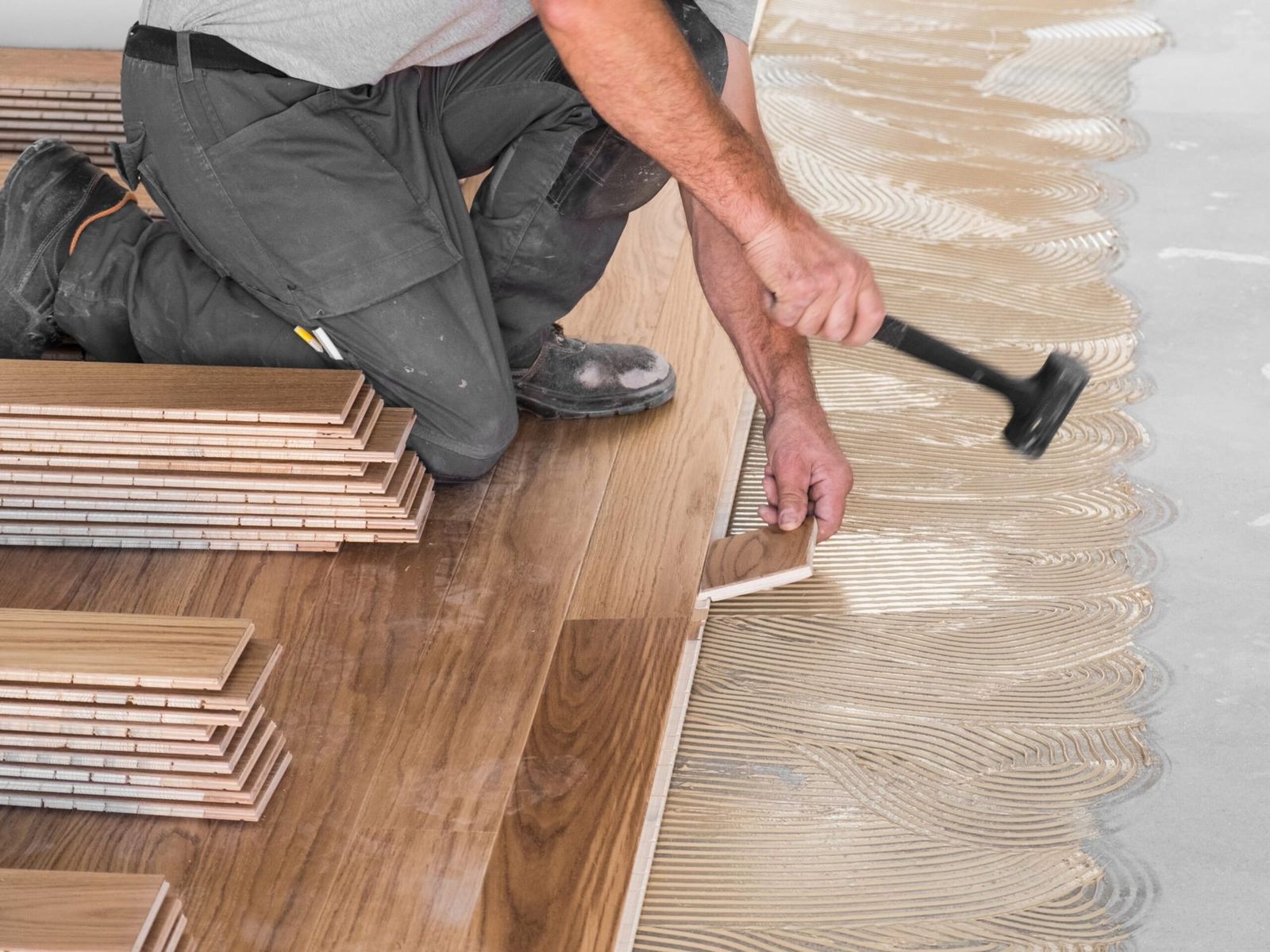
Because engineered boards lock together on all four sides, a single board can usually be swapped without lifting the whole floor. An installer carefully cuts out the damaged board, trims the locking profile on a new board so it can drop into place, and glues it in. Done well, the repair is very hard to spot. It’s worth keeping a box of spare boards from your original installation for exactly this reason.
Tip from Roman: always vacuum along the grain, not across it. If a piece of grit gets caught in the vacuum head and you push across the boards, you can leave one long scratch over several planks. Working back and forth with the grain greatly reduces the risk.
Water Damage on Timber Floors: Signs and Repairs
Water is the most common reason timber floors need repair or replacement. It can arrive suddenly, from a burst pipe, a leaking dishwasher or a storm, or slowly, through humidity, condensation and small ongoing leaks. In both cases, how quickly you act decides how much of the floor you can save.
Early signs
- Boards darkening near walls, doors or appliances
- Slight swelling along board edges
- A soft or spongy feel underfoot
- A musty smell in one area
Advanced damage
- Cupping, where board edges curl upwards
- Crowning or buckling across the floor
- Delamination, where the veneer lifts from the core
- Visible mould or persistent dampness
If you spot early signs, the floor can usually be saved. Typically only the affected planks need replacing, and the rest stays in place. Once boards have delaminated or mould has set in, there’s rarely an easy fix, and the affected section, or sometimes the entire floor, will need to be replaced.
Stop the water (straight away)
Turn off the source, then mop up standing water with towels.
Document it (first few hours)
Take clear photos and call your insurer if the damage is significant.
Dry the area (within 24 hours)
Use fans, air conditioning or a dehumidifier, and lift wet rugs.
Get it inspected (within 48 hours)
Ask your flooring installer to check moisture levels under the boards.
Avoid sanding, recoating or covering the damaged area until it has fully dried. Timber can take days or even weeks to dry out completely, depending on how much water soaked in and whether it reached the subfloor, so a moisture reading is far more reliable than how the surface feels. Trapping moisture under a new finish or a rug can turn a small repair into a full replacement.
Pet Urine: The Hidden Floor Killer
Warning: 60 to 90 minutes is roughly how long pet urine takes to soak through the coating and into the timber.
Why it’s so damaging
Even a small accident can leave a dark, round stain that’s almost impossible to remove. Once urine reaches the timber, it causes deep, permanent discolouration that often survives sanding. In most cases, replacing the affected boards is the only effective solution.
When inspecting a home to buy or rent, look for round, dark patches, particularly if a rug or piece of furniture has been placed conveniently over them. These marks usually point to pet urine damage that can’t be sanded away.
Solid Hardwood: Water Damage and Scratch Repair
Solid hardwood floors such as Spotted Gum, Blackbutt and oak react differently from engineered boards. Because they’re timber all the way through, they don’t delaminate. They still expand and contract with moisture, though, so instead of dramatic cupping you’re more likely to see gaps between boards or uneven joins. In older homes, this often shows up near sinks and dishwashers where small spills have happened for years.
If the boards are still structurally sound, a sand and refinish can often bring them back. Solid floors can be sanded many times over their life, effectively giving you a new surface every 10 to 15 years. The trade-off is that replacing individual solid boards is more involved, and usually means sanding and recoating a wider area so the finish matches. Read more in our guide to gaps between floorboards.
How Much Does Timber Floor Repair Cost in Australia?
| Repair | Typical cost (2026) | Best for |
|---|---|---|
| Filler or touch-up of light scratches | Low; DIY kits or a short call-out | Small surface marks |
| Replacing individual damaged boards | About $80 to $220 per board | Isolated scratches, stains or water damage |
| Sand and refinish (solid timber) | About $30 to $70 per m² | Widespread scratches, wear and light water marks |
| Repairing a water-damaged section | About $180 to $420 per m² | Larger areas needing drying, replacement and refinishing |
| Full floor replacement | Often $120 per m² or more, supplied and installed | Severe or widespread damage |
Indicative Australian ranges. Matching discontinued boards, subfloor repairs and furniture removal can add to the cost.
As a rule of thumb, timber floor repair usually makes sense when damage is limited to a few boards or the surface of a solid floor. Once damage is widespread, or the subfloor is affected, replacement often becomes the better long-term value.
When Replacement Is the Only Option
- Severe water damage with mould, delamination or persistent cupping
- Deep pet urine stains that have soaked into the timber
- Widespread scratching across large areas of an engineered floor with a thin veneer
- Damage that has reached the subfloor or underlay
If you do need new flooring, choose a product suited to how you live. Modern engineered timber comes in tougher, more scratch-resistant finishes, while hybrid flooring offers better water resistance for busy kitchens and rentals. See how our team handles timber floor installation or browse our engineered timber range.
How to Prevent Scratches and Water Damage
Clean gently
Vacuum along the grain and use a damp, never wet, mop.
Wipe spills fast
Pay extra attention near walls, doors and appliances.
Use felt pads
Stick them under furniture feet and renew them once they flatten.
Control humidity
In Queensland, air conditioning or a dehumidifier helps keep moisture stable.
Check regularly
Look for darkening near walls and edges, an early sign of leaks.
Mind the pets
Keep nails trimmed and clean up accidents straight away.
For a full care routine, read our guides on how to clean timber floors and how to clean hardwood floors.
Timber Floor Repair FAQs
Can scratches be removed from timber floors?
Light scratches can be filled or touched up, and deeper scratches on solid timber can usually be sanded out. On engineered floors with a thin veneer, badly scratched boards are often replaced individually instead.
Can water‑damaged timber floors be repaired?
Often, yes, if you act quickly. Early swelling and darkening can usually be fixed by drying the area and replacing affected boards. Delamination, mould and long-term water exposure usually mean replacement.
How do you fix a deep scratch in engineered timber flooring?
A surface repair specialist can sometimes fill it with tinted compounds. For long or deep scratches, the most reliable fix is cutting out the damaged board and installing a new one.
Can you sand engineered timber floors to remove scratches?
Only if the veneer is thick enough, usually 3mm or more, and even then only once or twice. Thinner veneers can’t be sanded safely, so board replacement is often the better option.
Can pet urine stains be sanded out of timber floors?
Rarely. Urine penetrates the coating within about 60 to 90 minutes and stains the timber deeply, so the affected boards usually need replacing.
How much does it cost to repair a timber floor?
Replacing individual boards typically costs about $80 to $220 per board, while a sand and refinish usually runs about $30 to $70 per m² in Australia. Larger water-damaged sections cost more.
Does home insurance cover water‑damaged timber floors?
Many policies cover sudden events such as a burst pipe, but not gradual leaks or wear. Take photos straight away and check your policy with your insurer.
How can I tell if my floor is water damaged?
Look for darkening boards, swelling or raised edges, a spongy feel underfoot or a musty smell, especially near walls, doors, sinks and dishwashers.
Not Sure If Your Floor Can Be Saved?
Send us clear photos of the damage, or visit our Newstead showroom. Our team will tell you honestly whether a repair or replacement makes more sense.