Choosing floors
Chevron vs Herringbone Flooring: Which Pattern Is Right for You?
 Roman Miller6 min read
Walk into any architectural residence or renovated Queenslander in Brisbane, and patterned timber floors instantly catch your eye. Parquetry flooring has experienced a major resurgence across Australian interiors, offering a bespoke, high-end alternative to standard straight-plank layouts.
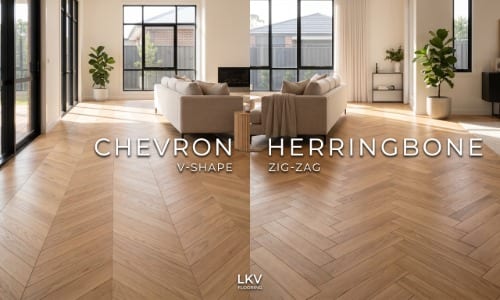
When selecting decorative parquetry, two classic styles dominate the conversation: Chevron and Herringbone. While both use geometric layouts to add texture and depth, they differ fundamentally in plank angles, laying complexity, material cutting waste, and overall installation cost.
In this comprehensive guide, the LKV installation team compares Chevron vs Herringbone flooring—explaining how the planks are manufactured, how they affect room dimensions, cutting wastage allowances, square-metre pricing, and which style suits your property.
Our honest verdict: is Chevron or Herringbone better for Australian homes?
For most Australian homes and family living spaces, Herringbone is our top recommendation. Its rectangular 90-degree planks provide balanced dimensional movement across open-plan layouts, reduce cutting waste to 10%–15%, and require lower trade installation costs. Choose Chevron if you want sharp, continuous V-shaped arrow lines to visually stretch hallways or create a luxury Parisian focal point—and your budget accommodates 15%–20% cutting wastage and specialised artisan installation.
LKV rating: Herringbone 4.8/5 for versatility; Chevron 4.5/5 for architectural luxury.
What Is the Structural Difference Between Chevron and Herringbone?
The core difference between Chevron and Herringbone comes down to how the plank ends are cut at the mill and joined across the subfloor:
- Herringbone planks are cut at 90-degree right angles. Planks are rectangular and laid in an alternating, staggered zig-zag pattern. The short header of one timber plank butts squarely against the side flank of the adjacent plank, creating a woven, stepped diagonal texture.
- Chevron planks are precision-cut at an angle (usually 45 or 60 degrees). The angled ends meet cleanly tip-to-tip along a central axis line, forming continuous, unbroken “V” arrow channels that run straight down the room.
| Specification | Herringbone Flooring | Chevron Flooring |
|---|---|---|
| Plank End Angle | 90° (Standard rectangular blocks) | 45° or 60° (Mitered angled ends) |
| Seam Geometry | Staggered, stepped zig-zag weave | Continuous, straight central V-seams |
| Cutting Wastage Factor | 10% to 15% surplus required | 15% to 22% surplus required |
| Laying Difficulty | High (Requires chalk-line balance) | Very High (Zero margin for angular drift) |
| Subfloor Flatness Req. | Within 3mm over 3m span | Within 2mm to 3mm over 3m span |
| Average Installed Cost | $135 – $260 / m² + GST | $165 – $300+ / m² + GST |
Chevron vs Herringbone: Side‑by‑Side Profiles
Herringbone profile
Classic European heritage and balanced rhythm
- Visual impact: Fluid, multidirectional weave. Because light hits opposing 90° blocks from different angles, timber grain depth is highlighted without harsh glare.
- Room effect: Broadens room proportions. Softens expansive open-plan spaces and prevents square rooms from looking boxy by pulling the eye outward diagonally.
- Best for: Open-plan kitchens, family living zones, dining pavilions, and classic Queenslander renovations.
Chevron profile
Haussmann Parisian luxury and linear symmetry
- Visual impact: Crisp, directional velocity. The unbroken V-arrow points draw your eye forward along the central seam toward windows or key architectural features.
- Room effect: Lengthens room depth. Creates an optical elongation effect, making compact entryways or hallways feel longer and more spacious.
- Best for: Entry galleries, long hallways, formal dining rooms, master suites, and luxury penthouses.
Herringbone Flooring: Key Architectural Advantages
Dimensional stability (5/5)
Alternating 90-degree planks naturally counterbalance timber expansion across the floor, significantly reducing seasonal movement during humid Brisbane summers.
Lower material wastage (4/5)
Because plank ends are cut square, perimeter off-cuts can often be reversed and reused at opposing walls, keeping scrap rates around 10% to 15%.
Wide material selection (5/5)
Manufactured across solid Australian hardwoods, engineered timber, hybrid flooring, and laminate—providing options for different price points and family lifestyles.
Timeless resale appeal (5/5)
Herringbone has proven its appeal across generations. Unlike short-lived trends, a quality parquetry timber floor protects and lifts property appraisal values.
Practical Realities & Technical Drawbacks
Subfloor prep: needs an exceptionally flat base
Geometric patterns highlight subfloor dips. Slabs must be diamond-ground or screeded to achieve levelness within 3mm across a 3m straightedge span before laying.
Chevron precision: zero room for joint error
Because Chevron ends meet tip-to-tip, an angular drift of just 1mm at the starter chalk-line compounds across the entire room, demanding seasoned installation trades.
Waste allowance: higher perimeter scrap rate
Angled Chevron planks meeting straight walls generate triangular remnants that cannot be repurposed, requiring 15% to 22% additional square meterage when ordering.
Trade labour: extended installation schedule
Standard straight planks install at roughly 40m² to 60m² per day. Detailed parquetry typically caps trade progress at 15m² to 25m² daily, extending on-site project times.
Timber Species Selection: Hardwood vs European Oak
Your timber species determines surface durability, dent resistance, and tone depth across high-traffic family zones:
| Timber Species | Janka Hardness | Aesthetic Character | Pattern Recommendation |
|---|---|---|---|
| European Oak (Engineered) | 5.5 – 6.0 kN | Consistent grain; accepts blonde, neutral, and smoked stains easily | Excellent for both Chevron and Herringbone |
| Spotted Gum | 11.0 kN (Ultra Dense) | Vibrant palette from pale amber to rich chocolate with wavy grain | Outstanding for Herringbone in high-traffic family homes |
| Blackbutt | 9.1 kN (Very Hard) | Warm honey to pale blonde tones with clean linear grain | Ideal for bright coastal and modern Hamptons parquetry |
| Tasmanian Oak | 5.5 kN | Warm cream, pale straw, and soft pink undertones | Suits traditional block parquetry and heritage restorations |
Cost Comparison: Material, Waste & Labour (Per m²)
| Expense Item | Herringbone Installation | Chevron Installation |
|---|---|---|
| Engineered Timber Supply | $65 – $140 per m² | $85 – $165+ per m² |
| Material Wastage Factor | +10% to +15% surplus | +15% to +22% surplus |
| Subfloor Prep & Moisture Barrier | $15 – $35 per m² | $15 – $35 per m² |
| Specialist Trade Labour | $55 – $85 per m² | $65 – $100 per m² |
| Estimated Total Investment | $135 – $260 / m² + GST | $165 – $300+ / m² + GST |
Frequently Asked Questions
Does Chevron or Herringbone make a small room look bigger?
Herringbone makes small or square rooms feel wider by drawing your eyes outward along staggered 45-degree diagonal lines. Chevron makes spaces feel longer by pulling line-of-sight forward along its continuous V-shaped arrow, making it ideal for narrow entryways and corridors.
Can you install parquetry over existing ceramic floor tiles?
Direct-stick timber parquetry should not be glued over glazed ceramic tiles, as bond delamination will compromise the floor. While click-hybrid herringbone can be floated over sound tiles using an underlay, permanent timber parquetry performs best when tiles are stripped back to structural concrete and treated with a moisture barrier.
Why is Chevron flooring more expensive than Herringbone?
Chevron planks require precision factory miter cuts, which raises raw production costs. On-site, perimeter wall cuts produce non-reusable triangular waste, pushing cutting allowances up to 22%. Installation labour is also priced higher due to the strict alignment required to keep apex points straight across long spans.
How should you clean and maintain patterned timber floors?
Vacuum regularly with a soft brush head to remove grit. Clean weekly with a well-wrung, damp microfibre flat mop and a pH-neutral timber floor cleaner formulated for polyurethane finishes. Avoid steam mops and heavy pooling water, which can penetrate bevelled seams and cause timber edges to swell.
Inspect Chevron & Herringbone Displays in Brisbane
Explore our complete range of parquetry flooring installation services or view our timber flooring installation options. Visit our Newstead showroom to compare full-size European Oak, Spotted Gum, and Blackbutt panels, or contact our Brisbane flooring team for a site measure and quote.